
What is MLS real estate listing? If you have ever searched for a home online and wondered how Zillow or Realtor.com got all those listings, you are about to find out.
The MLS, short for Multiple Listing Service, is the real backbone of the US real estate market. It is a private database where real estate agents and brokers share property listings with each other. Almost every home you see on a public website came from an MLS first.
If you are buying or selling a home, knowing how the MLS works can save you time, money, and a lot of confusion. Let me walk you through it in plain, simple language.
What Is MLS in Real Estate?
The Basic Definition of MLS
The Multiple Listing Service is a shared online database that licensed real estate agents and real estate brokers use to list and find homes for sale. Think of it like a big, private catalog of every property on the market in a given area.
When a seller hires an agent, that agent puts the home into the local MLS system. The listing includes details like the listing price, square footage, number of bedrooms, photos, and property features. Other agents can then see it and bring their buyers to tour the home.
I remember the first time a client asked me, “Can I just go to the MLS website myself?” Honestly, that is a fair question. But the truth is, the MLS is not open to the public. Only licensed professionals who pay membership dues can get full access.
How the MLS Concept Started
The idea behind the MLS goes all the way back to the late 1800s. Back then, real estate brokers would meet at their local association offices and simply tell each other what homes they had for sale. The deal was simple: “Help me sell my home and I will help you sell yours.”
According to the National Association of Realtors (NAR), this early cooperative agreement between brokers became the foundation of what we now call the MLS organization. Today, the same principle still applies. Brokers cooperate so that every buyer and seller gets the best possible outcome.
How Does the MLS Work?
The Role of Agents and Brokers
Here is how it works in real life. A homeowner decides to sell. They hire a listing agent. That agent enters the home’s details into their local MLS. Within hours, every other buyer’s agent in the area can see that new listing.
The MLS system also keeps some information private. Things like the seller’s contact details and showing instructions are only visible to agents who are members. This protects the seller’s privacy and keeps things safe.
Buyers who are not working with an agent cannot get that deeper level of detail. That is why having a licensed real estate agent on your side still matters a lot, especially in a competitive housing market.
What Information Is in an MLS Listing?
A typical MLS listing includes a lot of useful details. Here is a quick look at what you can usually find:
| Detail | Visible to the Public? |
|---|---|
| Listing price | Yes |
| Square footage | Yes |
| Number of bedrooms and bathrooms | Yes |
| Photos and virtual tours | Yes |
| Seller’s contact info | No, agents only |
| Showing instructions and offer deadlines | No, agents only |
The public-facing part flows out to websites like Zillow, Redfin, and Realtor.com through a process called data syndication. That is why those sites feel so complete when you search for homes. They are pulling from MLS data.
How Many MLS Systems Are There in the US?
A Network of Regional Databases
Here is something that surprises most people. The MLS is not one single website. It is actually a network of regional databases spread all across the country.
According to the Real Estate Standards Organization (RESO), as of July 2025, there are just over 500 MLS systems in the US alone, plus more than 30 in Canada. Each one covers a different area, from big cities to smaller rural counties.
Source: RESO MLS FAQ, July 2025
For example, the Chicago area uses MRED (Midwest Real Estate Data), while the Pacific Northwest has both RMLS and NWMLS. Some bigger cities even have more than one local MLS, which is why some agents pay dues to belong to multiple systems just to get wider access for their clients.
Why So Many Local MLS Systems?
Honestly, this is one of those things that confused me for a while too. Why not just have one big national MLS?
The answer is simple: real estate is local. A home in rural Wyoming and an apartment in Manhattan have very different rules, norms, and market conditions. Each local MLS is managed by a group of brokerages in that area. They know their market best, so they set the rules for their system.
The number of US MLS systems tends to get smaller each year as smaller systems merge together. But new ones are being created in places like Mexico, the Caribbean, and parts of Europe, which shows the MLS concept is spreading worldwide.
Who Can Access the MLS?
MLS Access Is for Licensed Professionals
Only licensed real estate agents and brokers who are members of a local MLS can access the full database. To join, they pay a membership fee and agree to follow the MLS rules for cooperative selling.
Regular buyers and sellers cannot log in and browse the MLS on their own. However, a big chunk of the listing data gets shared (or “syndicated”) to public sites like Zillow, Redfin, and Realtor.com. So while you cannot access the raw MLS, you are seeing most of its data when you browse those sites.
The key difference is that what you see publicly is sometimes a little delayed or incomplete. An agent who is directly inside the MLS system can see real-time updates that the public sites might miss by a few hours or even days.
Can You Buy or Sell Without MLS Access?
Yes, but it is harder. Some sellers choose to go the For Sale By Owner (FSBO) route, meaning they sell without an agent. In that case, their home does not automatically get listed on the MLS unless they pay a flat-fee broker to put it there.
The downside? Without an MLS listing, your home gets far less exposure. Most buyer’s agents search the MLS first, every single day. If your home is not there, a huge chunk of potential buyers will never see it.
If you are selling your home, getting it listed on the MLS is one of the most important steps you can take. More exposure means more buyers, which usually means better offers and a faster sale.
Why the MLS Is Good for Buyers and Sellers
Benefits for Home Sellers
When your home is on the MLS, it reaches a huge audience fast. Every agent in your area can see it and bring their clients to look. This cooperative selling system means your listing agent and hundreds of other buyer’s agents are all working toward selling your home.
More eyes on your property often leads to multiple offers. And multiple offers usually mean a better price for you. Without the MLS, sellers would have to rely only on their own agent’s network, which is much smaller.
The NAR puts it simply: sellers benefit from increased exposure to their property, and this is exactly what the MLS delivers.
Benefits for Home Buyers
For buyers, the MLS means you only need one agent to see all the homes available in an area. You do not have to call every brokerage in town or visit every office. Your agent searches the shared database and pulls up everything that matches what you need.
This saves so much time. I once worked with a couple who had been searching for a home for months on their own. When they finally connected with an agent who ran a proper MLS search for them, they found the right home within two weeks. That is the power of having full MLS access on your side.
MLS vs. Public Real Estate Websites
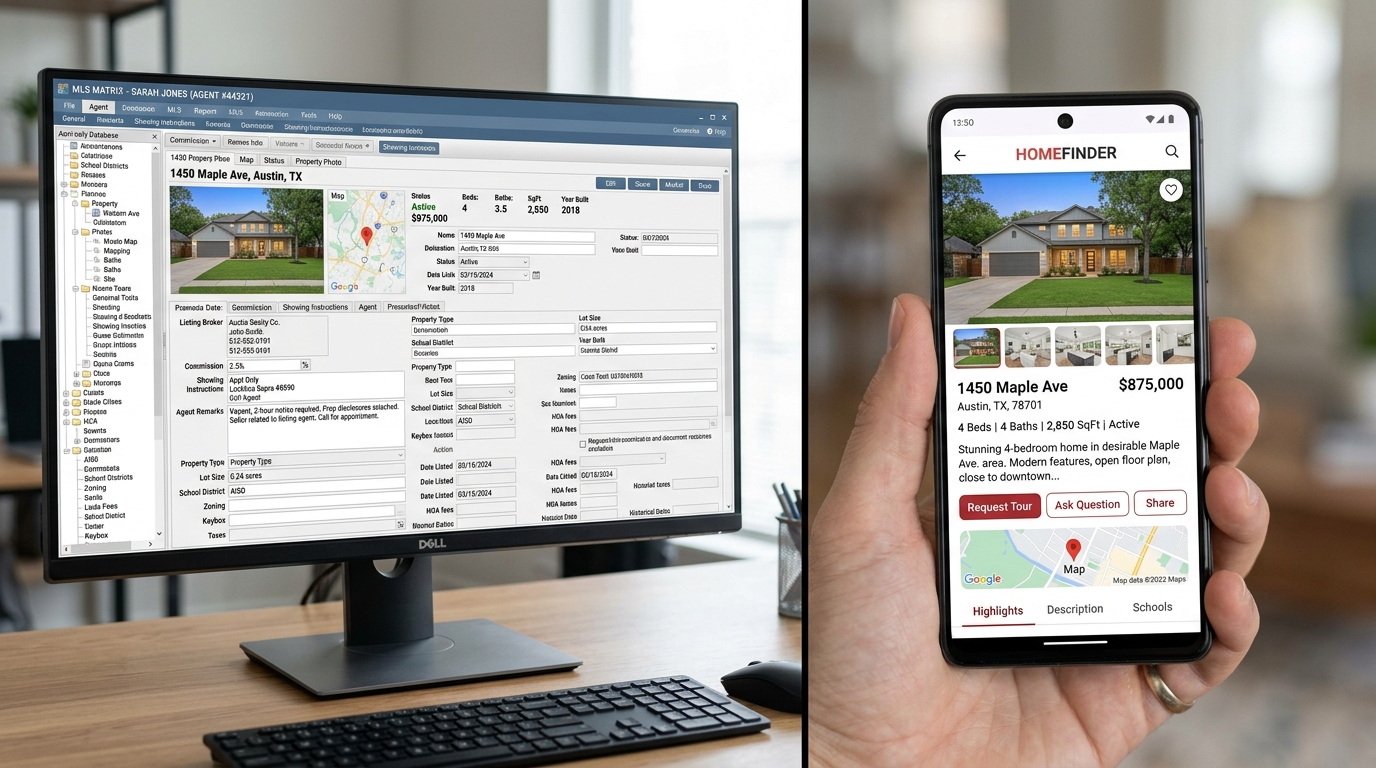
What Is the Difference Between MLS and Zillow?
This is one of the most common questions I get. Zillow, Redfin, and Realtor.com are public websites. They pull data from MLS systems and show it to anyone with an internet connection. That is a great thing for general searching.
But there are some gaps. Public sites sometimes show homes as “active” when they are already under contract. They may miss certain agent notes or special conditions that only show inside the MLS. And they usually have a time lag, sometimes a few hours, sometimes a full day.
The MLS is always the most up-to-date, most complete source. Public websites are great for getting ideas and doing early research. But when you are ready to get serious, you want an agent who is working directly inside the MLS.
How MLS Data Gets to Public Sites
When an agent puts a home on the MLS, the listing data gets shared out to dozens of websites automatically. This process is called data syndication. The MLS sends the listing information like price, photos, and property details to sites like Zillow, Redfin, Homes.com, and many others.
This is why you see so many of the same listings across different websites. They all come from the same original source: the local MLS database.
MLS and the 2024 Commission Rule Change
What Changed With Agent Commissions?
Starting in August 2024, a big change happened in how real estate agent commissions work. Before this, the standard model was that the listing agent and the buyer’s agent split a commission that was included in the MLS listing. The seller typically covered both.
After a major class-action lawsuit about agent commissions, this old “cooperative compensation” model changed. Now, agent commissions can no longer be listed inside the MLS. Buyers must sign agreements with their agents before touring homes, and they set their agent’s commission through direct negotiation.
This is a significant shift that changes how buyers and sellers plan their budgets. If you are buying or selling in 2025, it is worth talking to your agent early about how their commission is structured.
What This Means for You Today
To be fair, the change is still settling in. Some buyers are more aware of agent fees now, which is a good thing. Transparency in the process helps everyone make smarter decisions.
The MLS itself still works the same way. Homes still get listed. Agents still cooperate. Buyers still find homes through it. The only real difference is how the money part gets handled between agents and their clients.
Conclusion
The what is MLS real estate listing question has a pretty simple answer at its core: it is the main tool that keeps the US housing market running smoothly. Without it, buyers and sellers would have a much harder time finding each other.
The Multiple Listing Service connects listing agents and buyer’s agents, makes property information flow across the market, and gives sellers the widest possible reach for their homes. For buyers, it means one agent can show you everything available in one area, all in one place.
Whether you are buying your first home or selling one you have lived in for years, understanding the MLS gives you a real edge. And if you have questions about your specific market, the best next step is a conversation with a licensed real estate agent who knows your local MLS inside and out.
I’d love to hear if this helped you. Drop a comment or question and let me know what part of the MLS you want to understand better.
Frequently Asked Questions
What does MLS stand for in real estate?
MLS stands for Multiple Listing Service. It is a private database that licensed real estate agents and brokers use to share and find homes for sale. Each MLS covers a specific region, and there are over 500 of them across the United States.
Can I access the MLS without an agent?
No, the full MLS database is only available to licensed real estate professionals who are paid members. However, much of the MLS data gets shared to public websites like Zillow and Redfin, so you can browse listings there. For complete, real-time access, you need to work with a licensed agent.
What is the difference between MLS and Zillow?
The MLS is the original private database that agents use. Zillow and similar sites pull their listing data from MLS systems and display it to the public. MLS data is always more current and complete. Zillow can sometimes be delayed or missing key details that only appear inside the MLS.
How does a home get listed on the MLS?
A seller hires a licensed real estate agent. That agent enters the home’s details, such as price, photos, square footage, and property features, into their local MLS. The listing then becomes visible to all other agents who are members of that MLS, which gives the home wide exposure fast.
Is there a national MLS in the United States?
No, there is no single national MLS. Instead, the US has a network of over 500 regional MLS systems. Each one covers a specific area, from individual cities to multi-county regions. Some states have just a few large MLS systems while others have many smaller ones serving different local markets.