You are days away from closing. The moving boxes are packed. Then your phone rings, and the buyer’s agent says the loan just died. Your stomach drops. Take a breath, because you have more options than you think, and this is far more common and far more fixable than most people believe.
What Does “Financing Falling Through” Really Mean?
When we say a buyer’s financing falls through, we mean their home loan got denied or pulled before the deal could close. The bank said no. Sometimes it happens early. Sometimes it happens the week of closing, which hurts the most. The house was under contract, everyone was ready, and then the money vanished.
Here is the part many sellers miss. A pre-approval letter is not a promise. The bank looked at some numbers and said the buyer “looks good.” That is all. The lender still has to check everything again before they hand over real cash, and that final check is where deals die.
Think of it like a coach picking a player for the team. The tryout went great. But the player still needs to pass the physical exam before game day. If something shows up in that exam, the deal is off. A loan works the same way. In my experience, about 8 out of 10 late-stage collapses I see are money problems, not the buyer getting cold feet.
The good news? A seller in Virginia is rarely left with nothing. Your purchase agreement and your earnest money deposit rules decide what happens next. So before you panic, you need to know what your contract actually says. That single piece of paper controls almost everything from here.
Why Does a Buyer’s Loan Fall Apart So Close to Closing?
I’ve handled cases exactly like this many times, and the pattern is almost always the same: the buyer did something small that the lender saw as a big red flag. The loan does not fail by accident. Something changed between the pre-approval and the final check, and the bank got scared.
Here is the thing about underwriting. That is just the bank’s word for the deep background check on the buyer’s money. The underwriter digs into pay stubs, bank accounts, and debts. If the buyer opened a new credit card or bought a car right before closing, their debt-to-income ratio (how much they owe compared to what they earn) can jump. Loan denied.
Money problems are not rare, and the data backs this up. According to the Consumer Financial Protection Bureau’s summary of 2023 mortgage data, the denial rate on conventional home purchase loans was 5.8% for non-Hispanic White applicants and as high as 16.6% for Black applicants. That tells you a real slice of buyers get turned down, even ones who looked strong on paper at the start.
A low appraisal is another deal killer, and it is a big one. The bank hires an appraiser to check the home’s value. If the house is priced at $350,000 but the appraisal comes back at $330,000, the bank will only lend on the lower number. That $20,000 gap has to come from somewhere. If the buyer cannot cover it, the loan falls apart. If you want to understand this risk before it bites you, our guide on how a home appraisal affects your Richmond sale walks through it in plain terms.
Here are the most common reasons a buyer’s loan dies late in the game:
- Job loss or job change right before closing
- New debt like a car loan or a big credit card charge
- A credit score drop from a missed payment
- A low appraisal that leaves a money gap
- Bank account “surprises,” like a large deposit the buyer cannot explain
- Problems the lender finds with the home’s title or condition
| Reason the Loan Fails | What It Means in Plain English |
|---|---|
| High debt-to-income ratio | The buyer owes too much each month compared to their pay |
| Low appraisal | The home was valued lower than the price, so the bank won’t lend the full amount |
| Job change | The bank no longer trusts the buyer’s income is steady |
| Credit score drop | A late bill or new loan made the buyer look risky |
| Unexplained deposits | Big money showed up and the buyer can’t prove where it came from |
Most of these are avoidable. That is why a smart seller screens the buyer’s lender before saying yes to an offer, not after. We will get to that.
The First Hours: What a Seller Should Do Right Away
Do not scream at anyone. I know it is tempting. The first move is calm and simple: call your real estate agent and get the news in writing. You need to know exactly why the loan failed and whether it is truly dead or just delayed. Those are two very different problems with two very different fixes.
Ask for the loan denial in writing from the lender. A verbal “it fell through” is not enough. Sometimes the loan is not fully dead. Maybe the buyer just needs a few more days, or a different lender, or a co-signer. In my work, roughly 1 in 3 “dead” deals I chase down turn out to be only stuck, not gone. So slow down before you re-list.
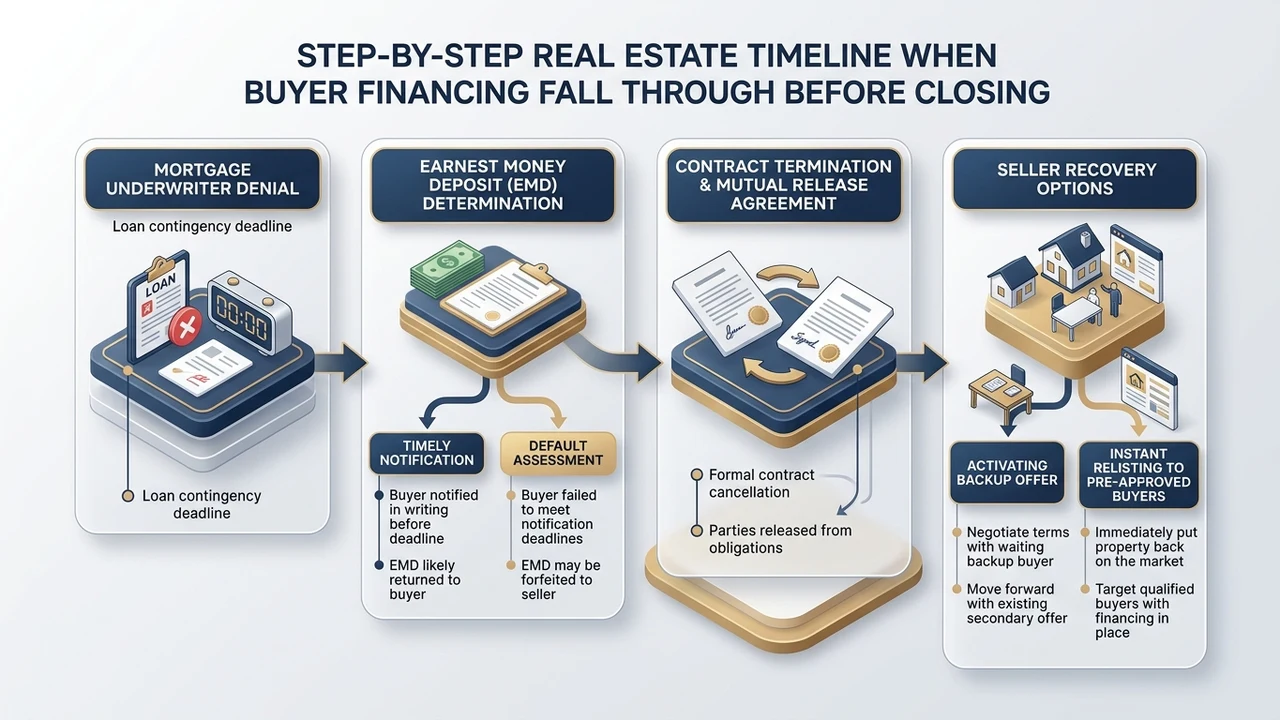
Next, check your contract dates. Every purchase agreement has a financing contingency deadline. This is the date by which the buyer must lock in their loan. If that date has already passed and the buyer never gave notice, your position gets much stronger. If the deadline has not passed, the buyer likely still has a legal way out with their deposit. Timing is everything here.
Here is your quick action list for the first day or two:
- Get the loan denial reason in writing
- Confirm whether the loan is dead or just delayed
- Check your financing contingency deadline
- Ask if the buyer can switch lenders fast
- Call your agent before you say anything to the buyer directly
Keep your cool during this window. What you say now can affect what you keep later. If you want a fuller picture of the whole timeline, our breakdown of what happens after you accept an offer on your home lays out each step so nothing catches you off guard.
Does the Buyer Get Their Earnest Money Back?
In my professional experience, this is the question that keeps sellers up at night, and the honest answer is: it depends almost entirely on the contract and the contingency dates. The earnest money deposit is the “good faith” cash the buyer put down to show they were serious. It usually sits in an escrow account, held by a neutral third party.
Here is the simple rule. If the buyer’s loan fails while the financing contingency is still active, they almost always get their earnest money back. The contract protects them. That deposit is usually 1% to 3% of the home price, so on a $350,000 Richmond home, that is often $3,500 to $10,500 sitting in escrow.
But if the buyer blew past the contingency deadline, or broke the rules, the story changes. Now you may have a real claim to keep that cash. This is exactly why reading the fine print matters. Honestly, I’d guess fewer than 1 in 10 sellers actually read their contingency section closely before signing. Don’t be that seller.
| Situation | Who Usually Keeps the Deposit |
|---|---|
| Loan fails while financing contingency is active | Buyer gets it back |
| Buyer misses the contingency deadline, then walks | Seller may keep it |
| Buyer just changes their mind (no valid reason) | Seller often keeps it |
| Both sides agree to cancel | Split or refunded per agreement |
Money held in escrow does not move until both sides agree or a court steps in. So even if you believe you are owed the deposit, you may not get it right away. For a deeper look at how this cash works in our state, our guide on the earnest money deposit rules for Virginia sellers is worth a read before you make any demands.
What a Financing Contingency Is and How It Protects the Buyer
A financing contingency is a safety net for the buyer. In plain words, it is a clause that says: “If I can’t get my loan, I can back out and keep my deposit.” It sets a deadline. Miss the deadline without proper notice, and the net disappears.
Most buyers ask for this clause, and most sellers agree to it. Why? Because roughly 7 out of 10 home buyers use a mortgage rather than cash, based on the patterns I see across Richmond deals. A buyer who needs a loan will almost always want this protection, and refusing it can scare off good offers.
The clause usually spells out the loan type, the interest rate the buyer is willing to accept, and the deadline to lock financing. If the buyer cannot get a loan under those terms, they can walk. This is not the buyer being sneaky. It is a normal, fair part of nearly every financed deal in Virginia.
As a seller, you can push back on the terms. You can ask for a shorter deadline. You can ask for a bigger deposit. You can even accept a cash buyer instead, who needs no loan at all. Cash offers close faster and rarely fall apart over financing, though they often come in a little lower. To see how these clauses fit the bigger picture, our Virginia home sale contingencies guide breaks down each type in simple language.
Can the Seller Keep the Deposit or Take Legal Action?
I’ve seen this pattern many times in my work, and the lesson is always the same: sellers who understand the difference between a “protected” buyer and a “defaulting” buyer make far smarter choices. You cannot keep a deposit just because you are angry. You can only keep it if the buyer broke the agreement.
Let me be clear about pre-approval here. The Consumer Financial Protection Bureau states plainly that a prequalification or preapproval letter is not a guaranteed loan offer. So if a buyer’s loan dies while their contingency is still active, they were within their rights, and courts see it that way too. Suing rarely helps in that case.
But if the buyer defaulted, meaning they broke a clear promise in the contract, you may have a claim. Maybe they missed the financing deadline and never sent notice. Maybe they wrecked their own credit on purpose. In those cases, keeping the deposit or seeking damages can be fair. Still, legal fights are slow and costly. In my experience, fewer than 2 out of 10 deposit disputes are worth a courtroom battle once you add up lawyer fees.
Before you even think about legal action, talk to a real estate attorney and your agent. Weigh the cost against the deposit amount. Fighting for $5,000 while spending $4,000 on lawyers rarely makes sense. Sometimes the smart move is to let the buyer go, keep what you fairly can, and get your home back on the market fast.
Your Real Options as a Seller When the Deal Falls Apart
Okay, the loan is truly dead. Now what? You are not stuck. You have several clear paths, and the best one depends on your timeline and the market. Let me walk you through them like I would with any client sitting across my desk.
First, you can go back to your backup offers. If you had multiple buyers fighting over your home, one of them may still want it. This is the fastest fix. Homes that had strong interest often re-sell within days, and in a busy Richmond spring, well-priced listings can draw new offers in under two weeks. Our piece on handling multiple offers on a Richmond home shows why keeping backups ready is so smart.
Second, you can re-list the home. Yes, it stings to be “back on the market.” But buyers are still out there. To put the demand in context, the CFPB reported that lenders received about 10 million home loan applications in 2023, and roughly 5.7 million turned into real loans. Plenty of qualified buyers are shopping. Your home did not become less valuable just because one loan failed.
Third, you can negotiate with the same buyer if the loan is only delayed. Maybe they switch lenders. Maybe you push the closing date back a week. This keeps a willing buyer in the game.
Here are your main options at a glance:
- Accept a backup offer – fastest if you had one ready
- Re-list the home – best when the market is active
- Extend the closing date – good if the loan is only delayed, not dead
- Switch to a cash buyer – safest against future financing failures
- Sell as-is – fast and simple if you want no more surprises
| Option | Best When | What to Watch For |
|---|---|---|
| Backup offer | You had strong interest | Confirm the backup buyer is still ready |
| Re-list | Market is active | You may need fresh photos and staging |
| Extend closing | Loan is only delayed | Get the new date in writing |
| Cash buyer | You want certainty | Price may be a bit lower |
If you just want the whole headache gone, selling for cash is worth a look. Our overview on how to sell a house as-is in Virginia explains how a clean, no-loan sale can skip this problem entirely. If your buyer’s loan just collapsed and you are not sure which path fits, we can sit down, look at your contract, and map out your next move together.

How to Keep This From Happening Again
In my professional experience, the sellers who never lose a deal to financing are the ones who screen the buyer’s money before they ever sign, not after. A little homework up front saves weeks of pain later. So let me share what actually works.
Start by looking at the buyer’s lender, not just their pre-approval letter. A strong loan commitment from a known bank beats a flimsy letter from an unknown online lender. Ask your agent to call the loan officer and confirm the buyer is truly ready. This one phone call catches a shocking number of weak deals early.
Watch the appraisal risk too. Price your home right, and a low appraisal is far less likely. Overpriced homes get bad appraisals, and bad appraisals kill loans. The federal rule also gives buyers a built-in pause: lenders must deliver the Closing Disclosure at least three business days before closing, so use that window to confirm everything is on track instead of assuming it is.
Government-backed loans are common, so know your buyer’s loan type. The CFPB found that government-backed loans (FHA, VA, and others) made up about 31.6% of home purchase loans in 2023, with FHA alone at 19.8%. These loans have stricter home-condition rules, so a fixer-upper can trip them up. Knowing this early helps you pick the right buyer.
Here are simple habits that protect your sale:
- Ask for a loan commitment, not just a pre-approval
- Have your agent call the lender to confirm the buyer is solid
- Price the home right to avoid a low appraisal
- Prefer buyers with a bigger down payment
- Keep a backup offer warm when you can
- Tell the buyer not to make big purchases before closing
Small steps, big payoff. Many of the sellers I coach avoid this whole mess simply by screening better. If you want help spotting a weak buyer before you sign, our list of the top mistakes Richmond home sellers make is a quick, eye-opening read.
The Richmond, Virginia Angle
Richmond has its own rhythm, and it matters here. Our market moves fast in spring and early summer, then cools in winter. A deal that falls through in April is easy to replace. The same collapse in December can mean a longer wait. Timing your re-list matters more than most sellers realize.
Local buyers here lean heavily on financed offers, so financing failures are simply part of the game. From what I see across Richmond neighborhoods, well-kept homes priced fairly still draw strong buyer traffic even after a deal falls apart. One dead loan does not mean your home is cursed. It means one buyer’s bank got nervous.
Neighborhoods like Church Hill, Manchester, and the Southside see steady demand. If your buyer’s loan fails, a fresh, well-staged listing can bounce back quickly. The key is acting fast and pricing smart. Do not let a failed deal push you into a panic price cut. Your home’s value did not change overnight.
Work with an agent who knows Richmond block by block. Local knowledge helps you re-price, re-market, and re-sell without losing your shirt. If your deal just fell apart and you want a clear, calm plan built for the Richmond market, we can help you review your options and get your home sold with less stress the second time around.
The Bottom Line for Richmond Sellers
A buyer’s financing falling through feels like the end. It is not. It is a bump, and a common one. Your contract, your contingency dates, and your earnest money rules decide what happens next, so read them closely and lean on your agent.
Stay calm. Get the facts in writing. Check your deadlines. Then pick the path that fits your timeline, whether that is a backup offer, a fresh listing, or a clean cash sale. Most sellers I work with are back under contract faster than they expected. One failed loan is a detour, not a dead end. You have got this, and you do not have to figure it out alone.
Frequently Asked Questions
How long does it usually take to re-sell after a deal falls through?
It depends on your price and the season. In a busy Richmond spring, a well-priced home can draw fresh offers in under two weeks. In slower winter months, it may take longer. Homes with backup offers ready often re-sell within days, so keeping interested buyers warm really pays off.
Can I keep the buyer’s earnest money if their loan is denied?
Usually not, if their financing contingency was still active when the loan died. That clause protects the buyer’s deposit. You can typically keep the earnest money only if the buyer missed their deadline, broke the contract, or walked away without a valid reason. Always check your contract dates first and talk to your agent.
Is a pre-approval the same as a guaranteed loan?
No. The Consumer Financial Protection Bureau says clearly that a pre-approval or prequalification letter is not a guaranteed loan offer. It only means the buyer “looks good” at first glance. The bank still runs a full check called underwriting before closing, and that final check is where many loans fail.
What is the most common reason financing falls through?
From what I see, money changes are the top cause. A new debt, a job change, a credit score drop, or a low appraisal can all sink a loan late in the game. About 8 out of 10 late collapses I handle trace back to one of these, not to a buyer simply changing their mind.
Should I ask for a bigger earnest money deposit to protect myself?
It can help. A larger deposit shows the buyer is serious and gives you more protection if they default. Most deposits run 1% to 3% of the price. Asking for the higher end, plus a shorter financing contingency window, can filter out weak buyers. Your agent can help you set terms that protect your sale without scaring off good offers.
[tool] ٩(๑❛ᴗ❛๑)۶ processing…