
You accepted an offer. You felt happy. Then the home inspection report showed up, and the buyers sent a long list of fixes they want you to make. Your stomach drops a little. Is this normal? Do you really have to say yes to all of it?
Take a breath. This step scares a lot of people who are selling, but it is one of the most normal parts of any sale. Almost every deal has a repair talk after the inspection. In the deals I have handled, about 9 out of 10 inspection reports flag at least a few items, even on newer homes.
This guide breaks it all down in plain words. You will learn what a repair request is, what you must fix, what you can say no to, and how to keep your buyer from walking away. I have walked many sellers in Richmond through this exact moment. It almost always works out fine when you stay calm and know your options.
What Is a Buyer Repair Request After a Home Inspection?
A repair request is simply a list. The buyer sends it to you after the home inspection is finished. It says, “Please fix these things before we buy your home.” Sometimes the buyer asks for money instead of repairs. Both choices are normal, and neither one means the deal is falling apart.
Here is the simple version of how it works. The buyer hires an inspector. The inspector checks the house from the roof to the basement. Then they write a report. The buyer reads it, picks the issues that worry them most, and asks you to make fixes. In my experience, a full inspection takes about 2 to 3 hours, and the report can run 20 to 40 pages long.
Do not panic when you see a big list. A long report does not mean your house is bad. Inspectors write down every tiny thing they spot, because that is their job. Most of the items are small. Only a handful will truly matter to the sale, and those are the ones you and your agent will focus on.
What Happens Right After the Inspection
I have handled this exact moment many times, and the pattern is almost always the same. The report lands, the buyer goes quiet for a day, and then the repair ask shows up. Knowing the steps keeps you calm and helps you plan your next move before the clock runs out.
Most buyers work inside an inspection contingency. That is a rule in the contract that gives them a set number of days to inspect the house and ask for fixes. This window is usually 7 to 10 days in many Virginia deals. If you want the full picture of these deadlines, our guide to home sale contingencies in Virginia walks through each one in plain language.
The whole thing moves fast, so timing matters a lot. Once the buyer sends the request, you often have only a few days to answer before the deadline passes. In my experience, most repair talks wrap up in 3 to 5 days once both sides start trading offers. To see how this fits the bigger picture, read our breakdown of what happens after you accept an offer.
The inspection report
The report is the buyer’s proof. It has photos, notes, and little labels like “safety issue” or “needs repair.” Some reports even rank each item by how serious it is. You do not have to fix everything on it. Think of it as a starting point for a talk, not a bill you must pay in full.
The repair request letter
This letter is where the buyer picks their battles. A smart buyer will not ask for every single thing. They pull the big items and leave the tiny stuff alone. In deals I have seen, buyers usually ask for only 5 to 10 items out of a report that might list 30 or more. That gap is good news for you.
Why Buyers Ask for So Many Repairs
Buyers are scared too. This is likely the biggest purchase of their life. When they read a scary report, they want to feel safe. Asking for fixes is how they calm their own nerves. It is rarely personal, and it is rarely an attack on you or your home.
There is also money on their mind. Many buyers are stretched thin after the down payment. With mortgage rates where they are today, an extra $3,000 repair bill can feel huge to a young family. So they ask you to cover it. This is normal buying behavior, not greed.
Some buyers also test the waters. They ask for a lot, hoping to get some of it. It is a bit like haggling at a yard sale. In my experience, about half of a typical repair list is stuff the buyer would drop if you pushed back politely. That is why a calm, fair answer beats a fast “no” almost every time.
The Main Types of Repair Requests
I have seen thousands of these lists, and they almost always fall into three buckets. Once you learn to sort them fast, the whole process feels less scary. You stop treating a scratched window the same way you treat a cracked foundation.
Sorting items this way also helps you spend your money where it counts. A safety problem can kill a deal. A cosmetic ding almost never does. In deals I have worked, safety and structural items make up only about 2 out of every 10 requests, but they carry most of the weight.
Here is a simple way to see the three main types side by side:
| Type of Repair | What It Means | Common Examples | Does the Seller Usually Pay? |
|---|---|---|---|
| Structural & Safety | Big problems that make the home unsafe or weak | Foundation cracks, bad wiring, roof leaks, gas leaks | Often yes |
| System & Function | Things that should work but do not | Broken furnace, old water heater, leaky pipes | Sometimes, often split |
| Cosmetic | Looks-only stuff that does not affect safety | Chipped paint, small nail holes, worn carpet | Usually no |
Keep this chart in your head when the list comes in. The top row is where you should pay attention. The bottom row is where you can often say a kind “no.” The middle row is where most of the real negotiation happens, and where a good agent earns their keep.
What Repairs Are Sellers Required to Make?
Here is the part that surprises most people. In Virginia, sellers are not required to make most repairs at all. The buyer can ask. You can say no. The buyer can then walk away or stay. That back-and-forth is the whole game.
But there are a few real rules. If your contract says you will fix something, you must fix it. If your loan type or the buyer’s loan has rules, those matter too. For example, some government-backed loans will not fund a home with peeling paint or a broken rail. In my experience, these loan-driven fixes show up in about 3 out of 10 financed deals.
You also carry a legal duty to be honest. You must tell the buyer about problems you already know. This is called disclosure, and it is a real responsibility you cannot skip. Our page on seller disclosure rules in Virginia spells out what you must share and what you can leave out.
So the short answer is this. You are almost never forced to fix cosmetic things. You are sometimes pushed to fix safety or loan items. And you always have to be truthful about what you know. Keep those three ideas straight and you will not get lost.
Can a Seller Say No to Repair Requests?
Yes. You can say no. That is your right as the seller, and saying no is a normal part of the talk. The real question is not “can I say no,” but “what happens if I do?” That is where strategy comes in.
When you say no, the buyer has choices. They can accept it and move on. They can push back and ask again. Or they can walk away and take their earnest money fight with them. In the deals I have handled, fewer than 1 in 10 buyers actually walk over a fair “no.” Most stay, because they already love the house and moving on is a pain.
Saying no works best when your reason is solid. “The home is priced for its age” is a strong reason. “I just don’t feel like it” is weak. A good “no” is polite, clear, and backed by facts. Pair it with a small yes somewhere else, and you keep the buyer feeling heard.
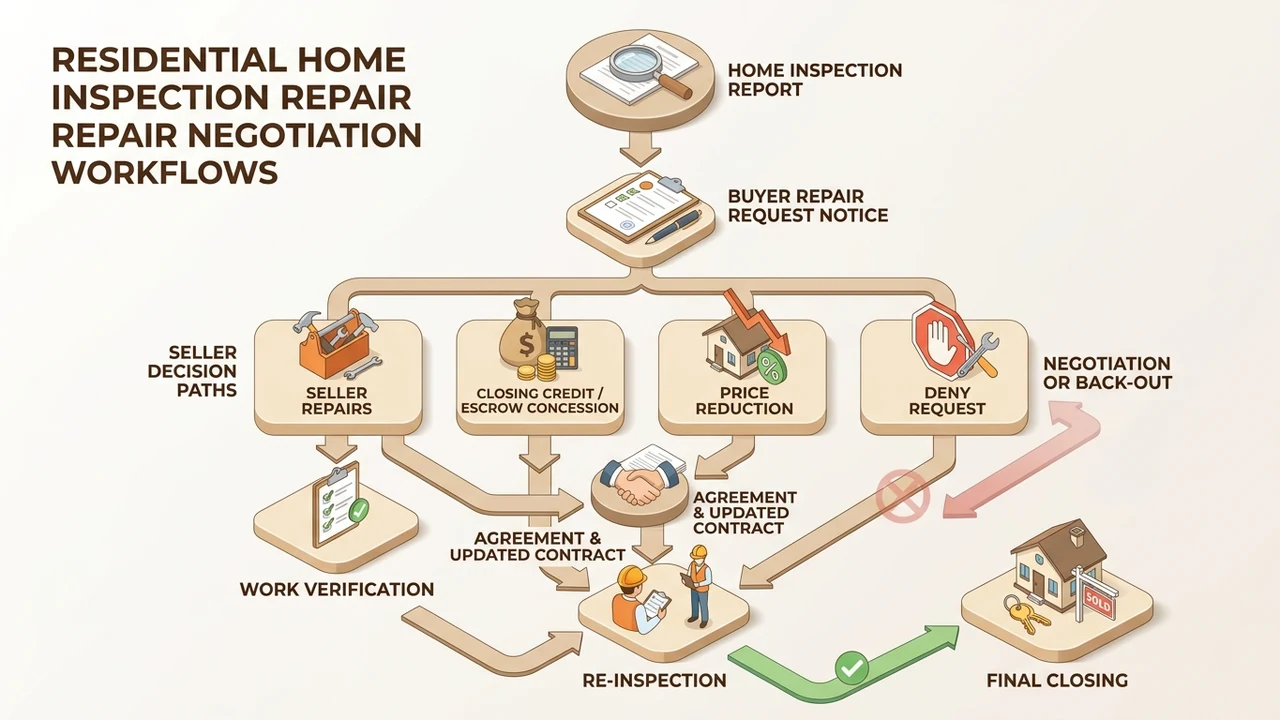
Your Four Ways to Answer a Repair Request
You are never stuck with just yes or no. You have four clear paths, and picking the right one can save you thousands. I coach my sellers to look at the whole list first, then choose one path per item. Mixing paths across the list is smart and very normal.
The trick is to match the answer to the problem. A safety issue may need a real fix. A small cosmetic gripe may deserve a firm decline. Money-back credits often work best for busy sellers who do not want workers in the house. In my experience, credits close deals about 20% faster than doing the repairs yourself, since there is no waiting on contractors.
Here are your four options in one view:
| Your Option | What It Means | Best Used When | Cost or Effort for You |
|---|---|---|---|
| Make the repair | You hire someone and fix it before closing | The item is a real safety or loan problem | Time and cash up front |
| Give a credit | You lower the price or give cash at closing | You want a fast, clean deal | Money, but no hassle |
| Meet halfway | You fix some items and decline others | The list is long and mixed | Balanced, most common |
| Decline politely | You say no with a clear reason | The asks are small or cosmetic | Low, but some risk |
A credit is the tool I reach for most. It is simple. The buyer gets money to fix things their way, and you skip the stress of finding a plumber in a rush. These credits often land between $1,000 and $5,000 in the deals I see, and they show up on your closing sheet. Our guide to closing costs when selling in Virginia shows how credits fit into your final numbers.
How to Negotiate Repair Requests Without Losing the Deal
Good negotiation is not about winning every point. It is about keeping the deal alive while protecting your wallet. I always tell sellers to answer within 24 to 48 hours. A fast, friendly reply lowers stress on both sides and keeps the buyer from getting cold feet.
Start by splitting the list into “will do,” “will credit,” and “won’t do.” Then send it back with a short, kind note. Never fight over small stuff. A $40 outlet cover is not worth risking a deal that took months to reach. In my experience, sellers who fight tiny items lose good buyers about 2 to 3 times more often than those who stay flexible.
Lean on real numbers when you push back. If a buyer wants a new roof but yours has years left, say so. Facts cool down hot requests. If you feel stuck, the steps in our guide on how to negotiate home sale offers can help you frame a fair counter that keeps things moving.
If the whole thing feels like too much, you do not have to do it alone. Our team can sit down with you, read the report line by line, and help you decide what is worth fixing and what is safe to decline. Sometimes one short call saves a deal that felt lost.
Health and Safety Items You Should Not Ignore
Now for the items I never tell a seller to brush off. Cosmetic stuff is one thing. Health hazards are another. When an inspection flags something that can hurt people, buyers get serious fast, and honestly, they should.
Radon
Radon is a gas you cannot see or smell. It creeps up from the ground into homes. It matters because, according to the U.S. Environmental Protection Agency, radon is the second leading cause of lung cancer and is linked to about 21,000 lung cancer deaths in the U.S. each year. The EPA suggests fixing a home when radon reaches 4 pCi/L or higher.
The good news? A radon fix is often cheaper than sellers fear. A basic system to vent the gas is a normal, well-known repair. If your buyer’s inspection flags radon, a simple test and a small system usually settle the worry and keep the deal on track.
Lead paint
If your home was built before 1978, lead paint is a real topic. Federal law is clear here. The EPA’s lead disclosure rule requires sellers of most pre-1978 homes to share what they know about lead paint and to give buyers a 10-day window to test for it. The EPA also notes that about three-quarters of homes built before 1978 still hold some lead-based paint.
You do not always have to remove the paint. But you must be honest and hand over the right forms. Skipping this step can bring real penalties, so treat it as a must-do, not a maybe. When paint is in good shape and sealed, it is often fine to leave in place.

Selling Your Home As-Is in Virginia
Here is a path many tired sellers forget they have. In my professional experience, roughly 1 in 5 sellers I meet would be happier selling as-is than fighting over a repair list. Selling as-is means you tell buyers up front, “What you see is what you get.”
Going as-is does not free you from telling the truth. You still must disclose known problems. It just means you are not promising to fix them. This can be a smart move for an old family home, a rental you are done with, or a house you inherited far away. Our full guide on how to sell your house as-is in Virginia lays out the pros and cons.
There is a trade-off, and you should know it. As-is homes often sell for a bit less, since buyers price in the risk. In the sales I have watched, as-is homes tend to close 5% to 10% below a fully fixed home in the same market. For many sellers, that discount is worth the peace of mind and the faster path to the finish line.
If you are not sure whether as-is fits your home, we are glad to look at your numbers with you. Sometimes selling as-is nets you more once you count the repair costs, the time, and the stress you skip. A quick chat can make the choice clear.
Mistakes Richmond Home Sellers Make With Repair Requests
I have seen the same slip-ups again and again with local sellers, so let me save you the pain. Richmond’s mix of old homes in areas like Church Hill and newer builds in the suburbs means repair lists here can look very different from one street to the next. Knowing your home’s age helps you guess what the buyer will flag.
The biggest mistake is taking the list personally. Sellers get angry, fire off a harsh “no,” and scare the buyer off. Slow down. A cool head wins here. In my experience, sellers who reply with anger lose their buyer about 3 times more often than those who stay kind and clear.
Here are the common traps I watch for:
- Fixing everything without asking your agent first, and wasting cash on stuff the buyer did not even want.
- Waiting too long to reply and blowing past the contract deadline.
- Ignoring safety items like bad wiring or radon, which can sink a deal fast.
- Hiding known problems, which breaks disclosure rules and can bring legal trouble.
- Over-negotiating the tiny stuff and losing a solid buyer over pocket change.
Avoid these five and you are already ahead of most sellers. For more local lessons, our list of top mistakes Richmond home sellers make is worth a read before you list.
Final Thoughts
A repair request is not the end of your sale. It is a normal middle step, and it is very fixable. In the deals I have handled, about 8 out of 10 stay alive and close after a fair repair talk. That number should give you real hope.
Keep it simple. Sort the list into big items and small items. Answer fast and stay kind. Fix the safety stuff, offer credits where it helps, and say a polite “no” to the tiny gripes. You hold more power here than you think, and a calm seller almost always comes out ahead.
You do not have to figure this out on your own. Whether you want help reading the inspector’s report, weighing a credit, or thinking about selling as-is, we are here for it. Reach out to our team, and we will help you find the smoothest path to your closing table.
Frequently Asked Questions
Do I have to fix everything the buyer asks for?
No, you do not. In Virginia, sellers are almost never forced to make cosmetic or minor repairs. You can fix some, offer money for others, and decline the rest. The main exceptions are items your contract promises and certain safety or loan-related fixes. In my experience, most sellers end up doing only about half of what the buyer first asks.
What happens if I say no to all the repair requests?
The buyer then decides what to do next. They can accept your “no,” push back with a smaller list, or walk away from the deal. If they walk, the fight often turns to the earnest money deposit. That said, fewer than 1 in 10 buyers actually leave over a fair, polite “no,” since most already want the home and dread starting over.
Is it better to make repairs or give a credit?
For most sellers, a credit is the easier road. You give the buyer money at closing, and they handle the work their own way. This skips the stress of finding workers on a tight clock. Credits also tend to close deals about 20% faster in my experience. Still, some loan or safety items truly need a real fix before closing, so match the choice to the problem.
How long do I have to respond to a repair request?
Usually not long, so move quickly. The buyer works inside an inspection contingency, often a 7 to 10 day window in Virginia deals. You typically have just a few days to reply once the request lands. I tell my sellers to answer within 24 to 48 hours. A fast, kind reply keeps the buyer calm and the sale on track.
Can I sell my house as-is to avoid repair requests?
Yes, you can. Selling as-is tells buyers you will not make fixes, though you must still disclose problems you know about. This can be a good fit for older or inherited homes. Just know that as-is homes often sell for 5% to 10% less than fully repaired ones. For many sellers, that trade is worth the saved time, cash, and stress.