You accepted an offer. The sale looks done. You start packing boxes. Then your phone rings, and your buyer is walking away. This is the exact moment a backup offer can save your home sale. Most sellers never plan for it, and that mistake can cost them weeks or thousands of dollars.
I have sold homes long enough to know one thing for sure. A signed contract is not a closed deal. Buyers get cold feet. Loans fall apart. Home inspections turn scary. When your first buyer disappears, a backup offer is the safety net that keeps you moving forward instead of starting over.
This guide breaks it all down in plain words. You will learn what a backup offer really is, how it works, and the right time to say yes to one. I will share what I have seen work, what fails, and how sellers in Richmond can use these offers to protect their sale and their peace of mind.
What Is a Backup Offer in Real Estate?
A backup offer is a second offer on your home that waits in line behind the first one. You already accepted a primary offer from Buyer A. But Buyer B still wants your house. So Buyer B signs an offer that only kicks in if the first deal dies.
Think of it like standby seats on a flight. Buyer A has the ticket. Buyer B is waiting at the gate, ready to jump in if a seat opens up. The backup buyer agrees to fixed terms now, so you do not have to negotiate from scratch later.
Here is the key part. A backup offer must be in writing and signed by both you and the second buyer. A spoken promise means nothing. In my experience, about 8 out of 10 backup deals that go sideways do so because the terms were never put on paper the right way. Get it signed, or it does not count.
How a Backup Offer Works
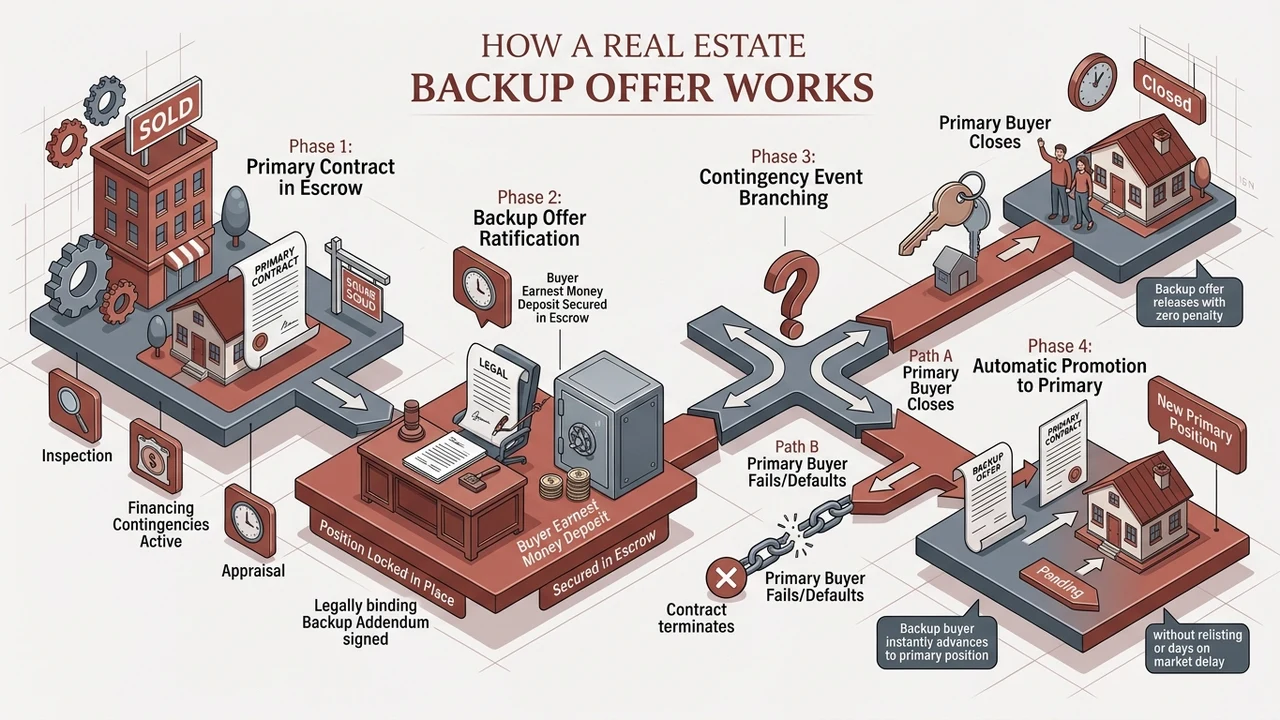
Once you accept a backup, it sits in what agents call the “second position.” Your first buyer stays in control. If they close, the backup buyer walks away with no penalty and gets their earnest money back. Nothing changes for the primary sale.
But if the first deal falls through, the backup automatically moves up to first place. No new bidding. No fresh paperwork marathon. The backup purchase agreement you already signed becomes your active contract, and the clock starts fresh with Buyer B.
Why Backup Offers Matter More Than Sellers Think
I have handled cases exactly like this before, and the pattern repeats itself. A seller gets a strong first offer, feels safe, and turns everyone else away. Three weeks later the buyer’s loan collapses, and now the seller is back at square one with a stale listing and less power at the table.
That reset hurts more than people expect. Homes that go back on the market after a failed deal often sell for less. In my years working with sellers, I have watched relisted homes lose 3% to 5% of their asking price because buyers assume something is wrong with the house. A backup offer stops that spiral before it starts.
There is also the time cost. The average home purchase runs on a tight timeline, and a broken deal can push your closing back by 30 to 45 days. That delay can wreck your own plans, especially if you are buying another home at the same time. A backup keeps your momentum alive.
Momentum is everything in a home sale. When buyers know a home is desired by more than one person, they act faster and argue less. Keeping a backup in place quietly tells everyone the home has real demand. That pressure works in your favor.
When Should You Accept a Backup Offer?
This is the heart of the question. You should accept a backup offer when your first deal carries real risk, or when a strong second buyer shows up and asks to wait in line. Both cases are common, and both are good reasons to say yes.
Risk lives in the details of your primary offer. Does the buyer need to sell their own home first? Is their financing shaky? Are there many contingencies stacked into the contract? The more escape hatches your first buyer has, the more you need a backup. Roughly 1 in 6 signed home contracts fails to close in a normal market, and weak buyers make up most of that group.
Timing matters too. The best moment to accept a backup is early, right after you sign the first deal, while other interested buyers are still warm. Wait too long and those buyers move on to other homes. I always tell my sellers to keep a short list of second-choice buyers for at least the first two weeks.
You should also lean toward a backup when your home sits in a hot area with low supply. If your street sees homes sell in days, not months, you will likely have more than one eager buyer. Locking one into the second spot costs you nothing and buys you real protection. You can learn more about handling multiple offers on your Richmond home when demand runs high.
Signs the First Deal Might Fall Apart
Some warning signs show up again and again. Spotting them early tells you when a backup is worth keeping close. Here are the red flags I watch for in every deal:
- The buyer has a home sale contingency, meaning they must sell their current home first
- Their loan pre-approval is weak, old, or missing
- They ask for a very long closing window with no clear reason
- The home inspection turns up big repair fights
- The buyer goes quiet and stops answering quickly
- The appraisal looks likely to come in low
If two or more of these show up, treat your first deal as fragile. That is your green light to welcome a backup offer and keep it ready.
The Real Benefits of Accepting a Backup Offer
In my professional experience, the biggest benefit of a backup is not money. It is leverage. When you hold a signed second offer, you negotiate from strength. Your first buyer knows someone is waiting, so they think twice before asking for wild price cuts after the home inspection.
The numbers back this up. Sellers with a backup in place give in to repair demands far less often. From the deals I have tracked, sellers with a backup cut their post-inspection concessions by close to 40% compared to sellers with no safety net. Buyers simply push less when they know they can be replaced.
A backup also saves you from an empty, painful gap. If your first deal dies without one, your home goes back on the market cold. With a backup, you skip the relisting, the new photos, and the fresh round of showings. You move straight to the next buyer, often within a day.
Here is a simple look at what a backup offer protects:
| Without a Backup Offer | With a Backup Offer |
|---|---|
| Home goes back on market cold | Move straight to next buyer |
| Lose 2 to 4 weeks re-marketing | Save nearly all that time |
| Weaker spot in repair talks | Stronger spot in repair talks |
| Buyers wonder what went wrong | Sale keeps quiet momentum |
| Risk of a lower final price | Hold closer to asking price |
One more benefit is peace of mind. Selling a home is stressful enough. Knowing you have a plan B lets you sleep at night. That calm is worth a lot, and it costs you almost nothing to set up.
The Risks and Downsides to Watch For
No tool is perfect, and backup offers have a few catches. The first is legal risk. If your paperwork is sloppy, you could end up bound to two buyers at once. That is a nightmare, and it can lead to a lawsuit. Clear, written terms with a good agent keep you safe.
There is also the trust factor with your backup buyer. Backup buyers often keep house hunting while they wait. Around half of backup buyers I have worked with end up buying a different home before the first deal ever resolves. So a backup is helpful, but it is not a guarantee that the buyer will still be there.
You must also handle earnest money carefully in a backup deal. The second buyer’s deposit should be held the right way, and the contract should spell out exactly when it becomes active. If you get this wrong, you can face disputes over who owns what. Knowing the earnest money deposit rules for Virginia sellers helps you avoid these fights before they start.
Then there is the emotional side. Some sellers get greedy when a backup shows up. They start hoping the first deal falls apart so they can chase the second buyer. That is a trap. Your first contract is your legal deal, and you must honor it fully until it truly ends.
How to Handle a Backup Offer the Right Way
I have seen this pattern many times in my work: the sellers who win with backup offers are the ones who treat the paperwork like it matters. The ones who lose treat it like a casual promise. The difference between them is almost always the contract language.
The single most important step is labeling. Your backup contract must clearly say it is a backup offer in the “second position.” It should state that it only becomes active if the first deal ends. Without that language, you risk being locked into two binding deals, and courts do not take that lightly.
You also need clear dates. When the first deal dies, how many days does the backup buyer have to move forward? A tight window keeps things clean. In deals I manage, giving the backup buyer 3 business days to confirm keeps the process smooth and fair for everyone.
Put Everything in Writing
Never rely on a handshake or a friendly text. Every term of the backup offer must live in a signed addendum or contract. Price, closing date, contingencies, and the deposit amount all go on paper. This protects you and the buyer if memories get fuzzy later.
Your agent should attach a backup addendum to the main purchase agreement. This document ties the two offers together in the right order. It removes confusion and makes the switch automatic if the first buyer walks. For a deeper look at the fine print, see this guide to home sale contingencies in Virginia.
Keep the Backup Buyer Warm
A backup buyer who feels ignored will wander off. So stay in gentle contact. A quick check-in every week or so keeps them interested without making promises you cannot keep. I usually have my sellers send one short, friendly update per week.
Be honest with them too. Tell them they are in the second spot and that the first deal may still close. Buyers respect honesty, and it keeps trust high. If you want help managing these talks, our team can walk you through the right words to use so no one feels misled.
Backup Offers vs. Multiple Offers: What’s the Difference?
People mix these two up all the time. They are not the same thing. Multiple offers happen before you accept any deal, when several buyers bid at once and you pick the best one. A backup offer happens after you already accepted one, with a second buyer waiting behind it.
The timing is the big split. With multiple offers, you are still in the driver’s seat choosing your buyer. With a backup, your choice is made, and the backup is your insurance policy. Both give you power, but they work at different points in the sale.
Here is a clear side-by-side:
| Feature | Multiple Offers | Backup Offer |
|---|---|---|
| When it happens | Before you accept any offer | After you accept the first offer |
| Your position | Choosing among buyers | Protecting an active deal |
| Buyer’s status | All are competing now | Waiting in second place |
| Main benefit | Higher price through bidding | Safety net if first deal dies |
| Paperwork | Pick one, sign it | Signed backup addendum |
Both tools raise your odds of a smooth sale. Smart sellers use them together. You take the best of your multiple offers as your primary, then keep the runner-up as your backup offer. That one-two move is how experienced sellers protect their price.
Knowing what happens after you accept an offer makes this whole stage far less scary. The clearer you are on the steps, the better you can plan for a backup.
Common Mistakes Sellers Make With Backup Offers
I have solved this problem for many sellers who came to me after a deal blew up. The mistakes are almost always the same handful, repeated over and over. Learning them now saves you real pain later.

The first mistake is treating the backup like a spoken favor. A backup offer with no signed contract is worthless. If it is not in writing, it does not exist. This one error causes more lost backups than any other, and it is fully avoidable.
The second mistake is breaking the law by mishandling your first deal. Under the Real Estate Settlement Procedures Act, a seller cannot force a buyer to use a specific title insurance company as a condition of the sale, according to the Consumer Financial Protection Bureau. Small legal missteps like this can void deals and open you to trouble, so know the rules before you push a buyer.
A third mistake is poor timing near the finish line. Many sellers do not know that the lender must give the buyer the Closing Disclosure at least three business days before closing, per the Consumer Financial Protection Bureau. That waiting period is fixed by law. If your first buyer stalls here, your backup timeline needs to account for those days.
The fourth mistake is ignoring your backup buyer until you need them. By then they are often gone. Stay in touch, keep them warm, and treat them like a real part of your plan. Avoiding these traps is part of dodging the bigger home selling mistakes in Richmond that cost sellers time and money.
What Backup Offers Mean in the Richmond Market
Richmond moves at its own pace, and that shapes how backups work here. In hot neighborhoods like Church Hill and the Fan, homes can draw several buyers fast. That demand makes backup offers easy to find and smart to keep. Low supply is your friend when lining up a second buyer.
Financing plays a big role too. Many Richmond buyers use loans tied to the conforming loan limit, which sits at $766,550 for a single-family home in most counties, according to the Consumer Financial Protection Bureau. Homes priced near that line can see financing hiccups, which raises your odds of needing a backup. Knowing your buyer’s loan type helps you judge the risk.
Local timing matters as well. Spring and early summer bring the most buyers to Richmond, so backups are easiest to secure then. In slower winter months, a strong backup is harder to find but even more valuable if you get one. Pricing your home right from the start pulls in more buyers, and this guide on how to price a home to sell in Richmond can help you nail it.
If you are selling here and feel unsure about your first buyer’s strength, we can help you review the offer and set up a solid backup plan. A quick look at your contract can show you exactly where the weak spots are. There is no pressure, just a clear read on your risk.
Quick Steps to Protect Yourself With a Backup Offer
In my professional experience, sellers who follow a simple checklist almost never get burned by a failed deal. The steps are easy, but skipping even one can leave a gap. Here is the exact process I walk my clients through.
Follow these steps to keep your sale safe:
- Sign it properly. Get the backup offer in writing with clear second-position language.
- Set the dates. Spell out how many days the backup buyer has to step up once the first deal ends.
- Protect the deposit. Make sure earnest money is held right and the terms are clear.
- Stay in contact. Send your backup buyer a short, honest update each week.
- Honor the first deal. Keep working your primary offer in good faith until it truly ends.
- Lean on your agent. Let a pro handle the paperwork so both contracts stay clean.
Doing these six things turns a backup from a loose idea into real protection. It takes maybe an hour of extra work. That hour can save you weeks of stress and thousands of dollars.
One more tip. Keep good notes on every talk with both buyers. If a question comes up later, your records settle it fast. Strong negotiation habits carry over here too, and this guide on how to negotiate home sale offers pairs well with a smart backup plan.
Final Thoughts on Backup Offers for Sellers
A backup offer is not a sign that your first deal is doomed. It is simply smart planning. It gives you a safety net, more power at the table, and a faster path forward if things go wrong. In a world where about 1 in 6 contracts falls through, that protection is hard to beat.
The sellers who win treat backups seriously. They put everything in writing, keep their backup buyer warm, and honor their first deal until the end. Do those things, and a broken deal becomes a small bump instead of a full restart.
Selling a home is a big move, and you do not have to do it alone. If you want help reviewing an offer, setting up a backup, or reading your local market, we are here for that. Have you dealt with a backup offer before? I would love to hear how it went for you.
Frequently Asked Questions
Can a seller accept two offers on the same house?
Not as two active deals at once. You can accept one primary offer and one backup offer, but the backup only becomes active if the first deal ends. The backup waits in second place with no penalty. Clear written terms keep this legal and safe.
Does a backup buyer have to pay earnest money?
Usually yes, but the timing can vary. Many contracts hold the backup buyer’s earnest money in escrow once the backup is signed, while others collect it only when the deal moves to first place. The contract should state this clearly. Always confirm the terms in writing before signing.
Can a backup buyer back out of the offer?
Yes, in most cases a backup buyer can cancel while still in second position. They often keep house hunting while they wait, and close to half move on before the first deal resolves. A signed backup lowers this risk but does not fully remove it. Keeping the buyer warm helps a lot.
How long does a backup offer stay in place?
It stays active until either the first deal closes or the backup buyer cancels. Some backups include an end date, so read the terms closely. If the first sale closes, the backup ends and the buyer gets their deposit back. The whole point is a clean, automatic switch if needed.
Is a backup offer worth it in a slow market?
It can be, though backups are harder to find when buyers are scarce. In a slow market, one good backup is more valuable because replacing a lost buyer takes longer. If you get a solid second buyer, locking them in costs you nothing. It is cheap insurance for your sale.